
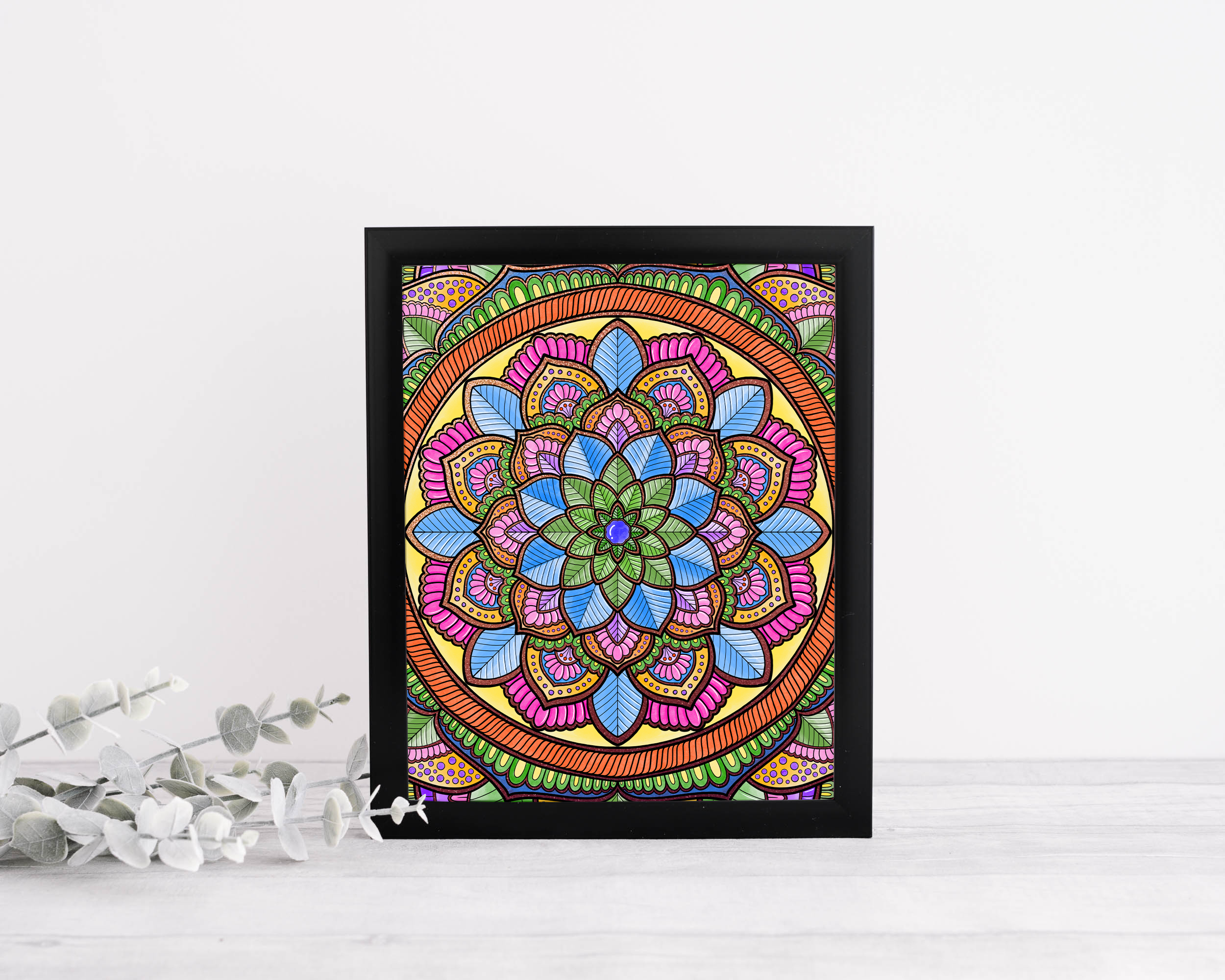
There is a moment — usually around the third hour of drawing — when the pen stops being an extension of your hand and becomes something else entirely. The repetition of petal shapes, the careful mirroring of each arc, the meditative discipline of working outward from a single center point: somewhere in there, the thinking mind quiets. What remains is pure attention. That, in its most honest form, is what mandala art has always been about.
At Shine Design Blossom, mandala art sits at the very heart of what we do. It is the bridge between our physical and digital worlds — a form ancient enough to feel eternal, yet flexible enough to live on screens, tablets, framed prints, and ceramic glazes alike. In this article, we want to share where mandalas come from, why they continue to resonate so deeply, and how we approach them in our own phygital practice.
Sacred Roots: Where It All Began
The word mandala comes from Sanskrit, meaning "circle" or, more poetically, "that which contains essence." Its earliest documented appearances trace back over 4,000 years to the Hindu Rigveda, where circular diagrams were used in ritual and cosmological illustration. In Buddhism, mandalas served as visual representations of enlightened mind-states — intricate maps of the universe that monks would construct in colored sand over weeks, only to sweep them away upon completion as a teaching on impermanence.
Across cultures and centuries — Tibetan thangka paintings, Navajo sand paintings, Gothic cathedral rose windows, Islamic geometric tile work — humans have returned again and again to the circle as a symbol of wholeness, protection, and the cyclical nature of existence. Carl Jung, who famously drew a mandala every morning as part of his psychological self-examination, called them "the psychological expression of the totality of the self."
"The mandala is an archetypal image whose occurrence is attested throughout the ages. It signifies the wholeness of the self." — Carl Jung
What strikes us about this history is not its length, but its consistency. Across radically different civilizations with no contact with one another, the impulse to draw from a center outward — to find order in symmetry, to locate oneself within a larger whole — arose independently and persistently. That is not coincidence. That is something woven into the fabric of human perception.
The Geometry of Calm: Why Mandalas Are Meditative
Modern neuroscience has begun to catch up with what practitioners have known intuitively for millennia: creating or contemplating mandalas produces measurable effects on the nervous system. Studies in art therapy have found that mandala coloring and drawing can reduce cortisol levels, lower anxiety, and increase focused attention — effects comparable to formal meditation practice.
The mechanism is elegantly simple. A mandala demands a specific kind of attention: sustained, non-judgmental, and detail-oriented. You cannot rush a mandala. Each petal, each geometric division, each layer radiating outward from the center asks you to slow down and be present with this mark, right here, right now. The mind, given a structured task that engages it fully without overwhelming it, settles. The background noise softens.
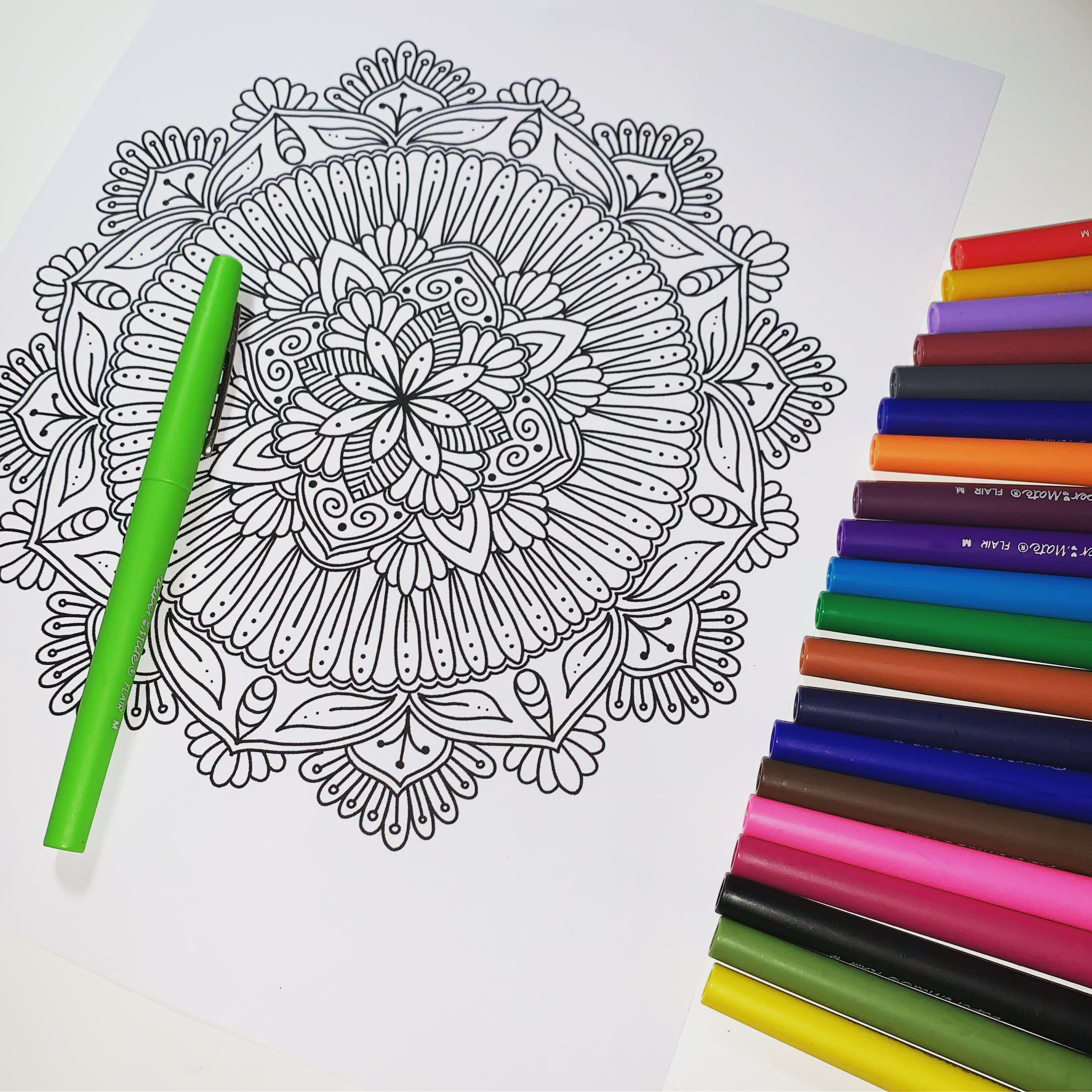
The process is as meaningful as the finished piece — each stroke a small act of presence.
This is why we believe so strongly that the act of making a mandala matters as much as the finished piece. When someone asks us how to start, we never say "find a template." We say: pick a center point. Draw a circle around it. Then ask: what wants to grow outward from here? The answers surprise people. They almost always say it felt like the mandala drew itself.
The Phygital Mandala: Our Process at Shine Design Blossom
We work in what we call the phygital space — that fertile zone where physical craft and digital precision meet and enhance each other. For our mandala pieces, this means a two-stage process that honors both worlds.
Every piece begins by hand. We use fine-liner pens, watercolor washes, and in some cases colored markers to build the initial composition on heavy archival paper. There is no undo button here. Every wobble in the line, every slight asymmetry, every place where the ink bloomed just a little too far — these are not mistakes to be corrected. They are the evidence of a human hand, and they carry a warmth that pure digital geometry cannot replicate.
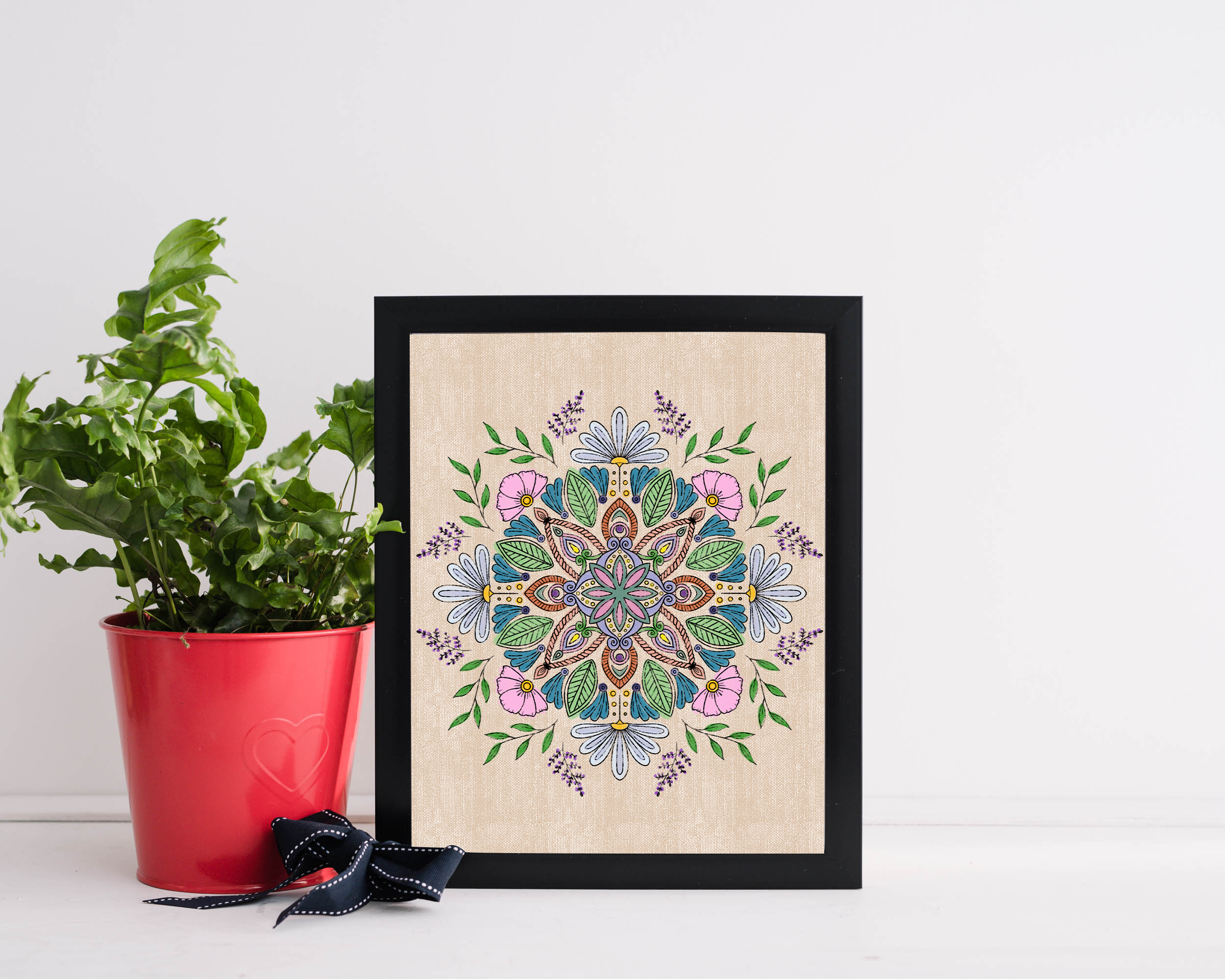
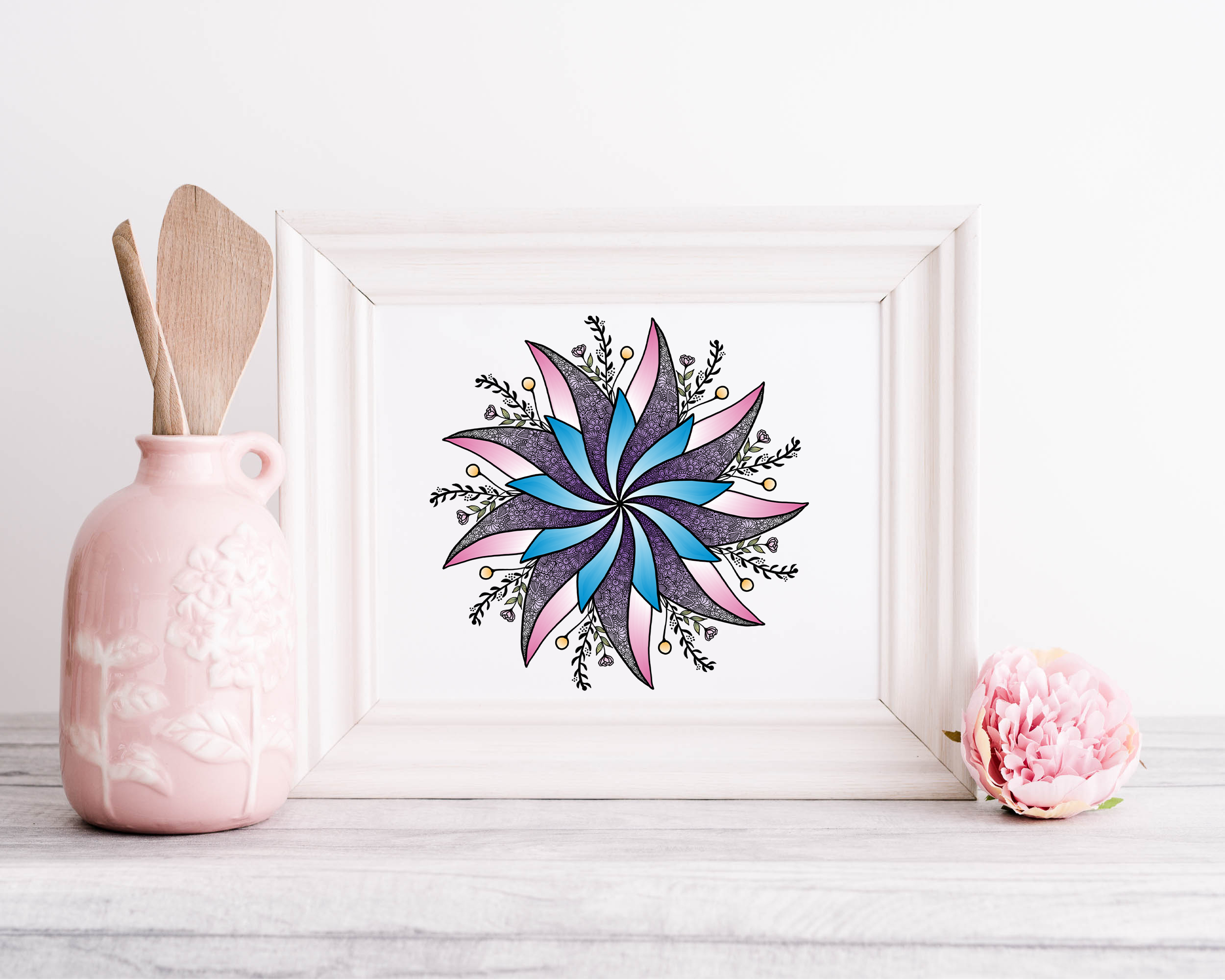
Once the physical piece is complete, we scan it at high resolution and bring it into our digital workflow. Here, we have the freedom to explore color relationships and compositions that would be impossible or irreversible in physical media. We might shift the entire palette to a cool water-teal, experiment with a deep navy ground, or isolate elements and scale them into something that feels monumental. The physical piece gives us the soul; the digital space gives us the range.
The final step brings us back to the physical. Digital files become giclée prints on museum-quality paper, ceramic glazes for vessels and tiles, or textile prints for home goods. The piece completes its journey: it began as something you could touch, became something you could endlessly refine, and returns as something you can live with.
Bringing Mandala Art Into Your Space
One of the questions we hear most often is: how do I incorporate mandala art into a modern home without it feeling too decorative or eclectic? The answer, we have found, is almost always about scale and restraint.
A single large mandala print — hung alone on a clean wall with generous breathing room — has far more presence than a gallery wall full of smaller pieces. Let the geometry do the work. The eye naturally travels inward toward the center, then spirals back outward through the layers. This movement is itself calming. It turns a wall into an invitation to pause.
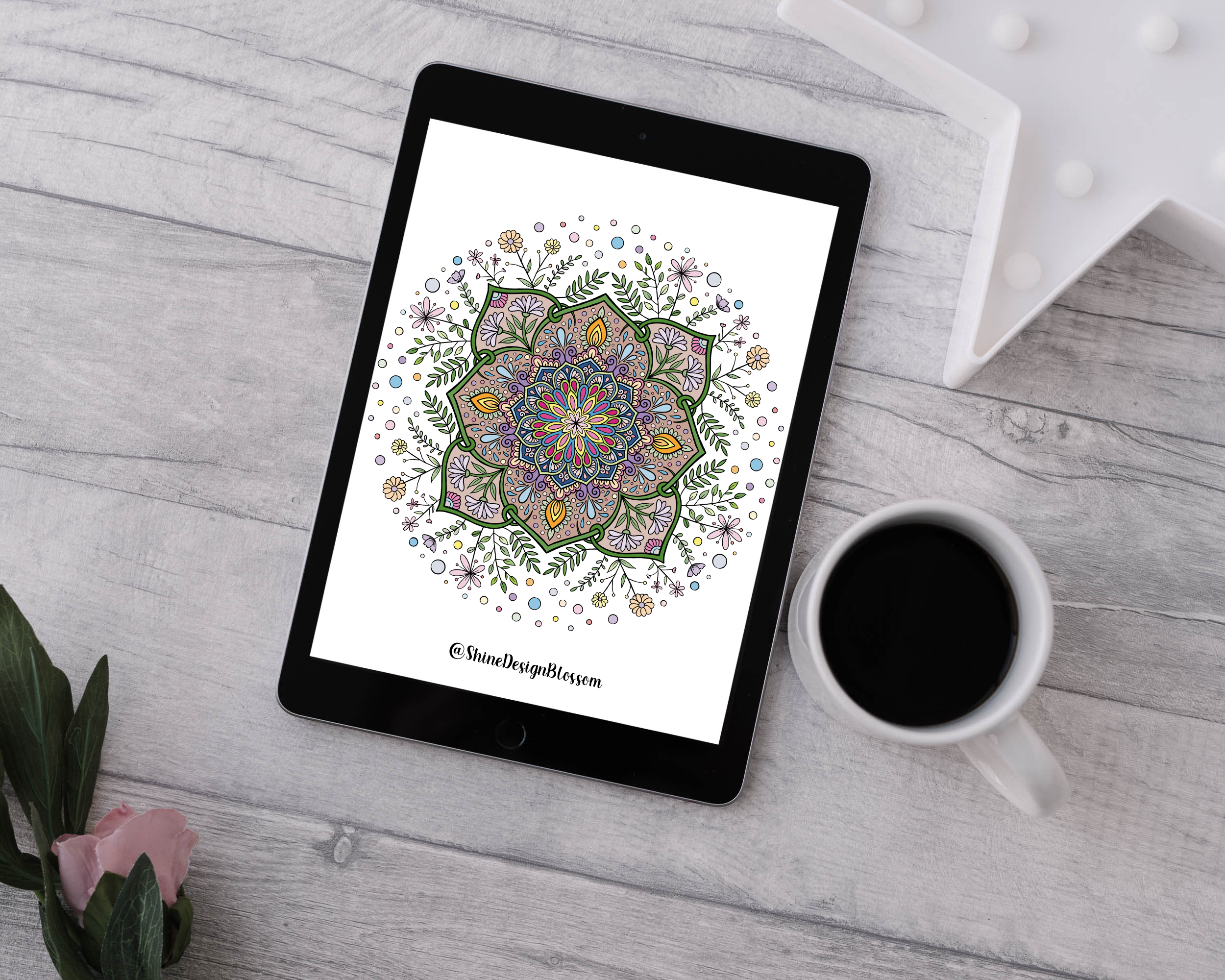
Our art lives equally well on screens and walls — the definition of phygital.
For those who want to start smaller, a framed A3 or A4 mandala print on a bedside table or desk creates a natural focal point for the beginning and end of the day. Many of our customers tell us they find themselves looking at it during moments of stress — not analytically, just resting their eyes on the pattern — and emerging from those moments feeling slightly more settled.
Color matters enormously in this context. Our botanical and organic mandalas — those with leaf and petal motifs worked into the geometry — tend to integrate beautifully into natural material palettes: linen, oak, terracotta, stone. Our more graphic, high-contrast pieces work well as counterpoints in more minimal, monochrome spaces where they become the sole source of warmth and complexity.
A Living Tradition
What moves us most about mandala art — after years of making it, studying it, and watching it land in people's homes — is that it has never needed to be updated. It arrived whole. Every generation rediscovers it not because someone decided it was fashionable, but because the act of sitting at a center point and drawing outward speaks to something so fundamental in human experience that no era can exhaust it.
At Shine Design Blossom, we do not think of ourselves as inventors. We think of ourselves as participants in a conversation that began long before us and will continue long after. Our contribution is to carry it into a new medium — to honor the hand-drawn line while embracing the tools that let that line live in more places, in more forms, in more hands than ever before.
If you have never drawn a mandala, we gently encourage you to try. Not for the result. For what happens in the drawing — the quieting, the centering, the slow and absorbing pleasure of a pattern that grows from nothing into something that feels, somehow, like it was always there waiting to be found.